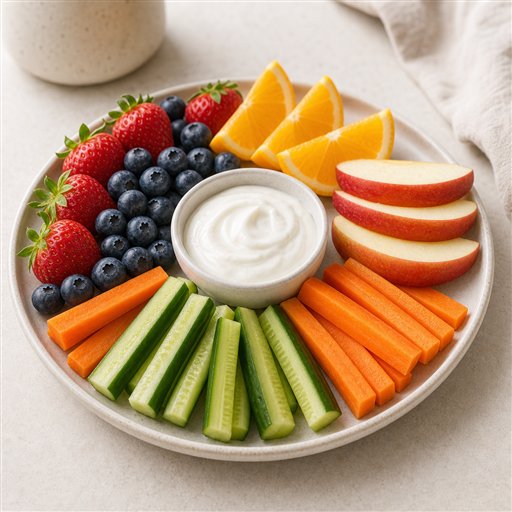
If you have ever watched a broccoli floret get quietly moved to the edge of the plate, you know the standoff well. Here is the good news: you do not have to win every vegetable battle to help your child eat well. When a veggie gets a hard pass, even after a small "no thank you bite," you can often offer a fruit from the same color family and still provide many of the same helpful plant nutrients.
Think of color as a simple shortcut, not another dinner rule. Here is why it works and how to use it without adding pressure at the table.
First, the "No Thank You" Bite
The "no thank you bite" is simple: your child takes one small taste of a new or less familiar food. If they still do not like it, they can politely say, "No, thank you," and leave the rest. No pressure. No power struggle. And yes, we may or may not have borrowed the term "no thank you bite" from our favorite show, Bluey.
Why offer a bite if your child may still say no? Because learning to like a food takes practice. Repeated, low-pressure exposure can help children become more comfortable with vegetables. Some children may need eight, ten, or even more tries before a food feels familiar. Keep offering it, keep the mood calm, and keep the portion tiny.
Feeding specialists also use a strategy called food chaining. It helps a child move from a food they already enjoy to a similar food that feels less familiar. The foods may share a color, texture, shape, or flavor. A color-matched fruit swap is one easy way to use the same idea at home.
Why Color Is a Helpful Nutrition Shortcut
The color of a fruit or vegetable is more than decoration. It gives us clues about the natural pigments and plant compounds inside. Carotenoids, anthocyanins, chlorophyll, and other flavonoids help give produce its color. Many of these compounds also support the body's natural defenses against oxidative stress and inflammation.
Fruits and vegetables that share a color often contain some of the same pigments. That means an orange mango or cantaloupe can offer some of the same carotenoids found in an orange carrot. It is not an exact match, but it can be a helpful backup when vegetables are not happening today.
Your Color-Match Cheat Sheet
| Color | Star pigments & nutrients | Why it helps | Veggie → fruit swap |
|---|---|---|---|
| Red / Purple / Blue | Anthocyanins (a polyphenol), plus lycopene in some reds | Potent antioxidants tied to heart and metabolic health | Red cabbage or beets → blueberries, blackberries, red grapes, cherries |
| Orange / Yellow | Beta-carotene & other carotenoids (converted to vitamin A), vitamin C | Supports eyes, skin, and immune function | Carrots or sweet potatoes → mango, cantaloupe, apricot, orange |
| Green | Chlorophyll, lutein & zeaxanthin, vitamin C, folate | Eye health and overall antioxidant support | Spinach or peas → kiwi, green grapes, honeydew, green apple |
| White / Tan | Flavonoids and other protective compounds | Antioxidant and heart-friendly | Cauliflower → banana, pear, white peach |
A few helpful things to know:
- Red, purple, and blue foods often get their color from anthocyanins. You will find these plant compounds in foods such as blueberries, blackberries, red cabbage, and eggplant. They have been studied for their role in supporting heart and metabolic health.
- Orange and yellow foods contain carotenoids such as beta-carotene. The body can turn beta-carotene into vitamin A, which supports healthy vision and immune function.
- Green foods can provide chlorophyll, lutein, zeaxanthin, vitamin C, folate, and other nutrients. Lutein and zeaxanthin are carotenoids that collect in the eye and help support vision over time.
One Honest Caveat
Color matching is a helpful backup plan, not a perfect one-to-one trade. A fruit and vegetable of the same color may share pigments and plant compounds, but they are not nutritionally identical. Vegetables, especially green and cruciferous vegetables, can provide fiber, minerals, and compounds such as glucosinolates that most fruits do not. Fruit may contain more natural sugar. Keep gently offering vegetables alongside the fruit swaps, without pressure or guilt.
The Takeaway for Tonight's Dinner
- Offer the vegetable and invite one small "no thank you bite." Keep it low pressure.
- If the answer is no, match the color with a fruit your child already enjoys.
- Mix up the colors across the week. The goal is variety over time, not perfection at one meal.
- Offer the vegetable again another day. Comfort and curiosity can grow one calm bite at a time.
Picky eating is common, and it does not mean you are doing anything wrong. Keep the table calm, celebrate small wins, and look for simple ways to add color. Progress can be slow, but every positive food experience counts. For more ideas, see Veggie Swaps for Kids and 7 Gentle Tricks to Get Kids Loving Fruits and Veggies.
This blog is for general education and is not a substitute for advice from your child's pediatrician. Talk to your doctor about your child's specific nutrition needs or ongoing feeding concerns.
References
- Appleton KM, Hemingway A, Rajska J, Hartwell H. Repeated exposure and conditioning strategies for increasing vegetable liking and intake: systematic review and meta-analyses of the published literature. Am J Clin Nutr. 2018;108(4):842-856. doi:10.1093/ajcn/nqy143
- Spill MK, Johns K, Callahan EH, et al. Repeated exposure to food and food acceptability in infants and toddlers: a systematic review. Am J Clin Nutr. 2019;109(suppl 1):978S-989S. doi:10.1093/ajcn/nqy308
- Milano K, Chatoor I, Kerzner B. A functional approach to feeding difficulties in children. Curr Gastroenterol Rep. 2019;21(10):51. doi:10.1007/s11894-019-0719-0
- Espley RV, Jaakola L. The role of environmental stress in fruit pigmentation. Plant Cell Environ. 2023. doi:10.1111/pce.14684
- Rudrapal M, Khairnar SJ, Khan J, et al. Dietary polyphenols and their role in oxidative stress-induced human diseases: insights into protective effects, antioxidant potentials and mechanisms of action. Front Pharmacol. 2022;13:806470. doi:10.3389/fphar.2022.806470
- Mirmiran P, Bahadoran Z, Moslehi N, et al. Colors of fruits and vegetables and 3-year changes of cardiometabolic risk factors in adults: Tehran Lipid and Glucose Study. Eur J Clin Nutr. 2015;69(11):1215-1219. doi:10.1038/ejcn.2015.49
Plan a colorful week of family meals
Use AIM to build a week of rainbow-friendly meals your kids will actually try, along with a ready-to-shop grocery list.
Build my meal plan